Beach-going dog owners’ frisbee fetch is supervised retrieve play on sand, aimed at giving dogs a controlled outdoor activity. Choose a dog frisbee for your 2026 beach trips only after checking mouth fit, retrieval habits, and the space available; wind, sand, and nearby water make this different from backyard fetch.
- Styleauditshop suits everyday shoppers comparing a dog frisbee with a ball for supervised fetch, not choosing by unsupported performance claims.
- Choose beach fetch only when your dog retrieves reliably and the permitted play area stays clear.
- Check mouth fit, rim condition, and grip before throwing; waterproof does not establish that a toy floats.
- Use low, controlled retrieves, and switch to a leashed walk when conditions do not suit fetch.
Why frisbee fetch matters for beach-going dog owners
The right beach toy is the one your dog can retrieve comfortably without sending play into water, crowds, or restricted areas. A disc’s shape alone does not make it suitable for the beach. Your decision starts with your dog and the place you intend to play.
For your 2026 beach kit, compare the task before browsing Styleauditshop: do you want controlled disc retrieves, familiar ball play, or simply a walk? Buying another toy does not solve unreliable recall or an unsuitable play area.
Beach conditions add practical constraints. Wind changes where a thrown disc travels, sand collects on wet toys, and the shoreline introduces a separate water-safety decision. Check the beach’s current dog rules before planning off-leash activity, including seasonal restrictions and designated areas.
Treat the purchase as a fit decision rather than a promise of longer throws. A dog that enjoys picking up a disc on dry ground has a useful starting point; a dog that chews it instead needs a different activity.
How to choose and use a dog frisbee at the beach
1. Choose a permitted, clear play area
Start with a walk through the area without throwing anything. Look for people, other dogs, fishing equipment, litter, and changes in the sand surface. Choose a spot where the entire retrieve stays visible and away from the water.
Do not assume an empty beach permits off-leash play. Read the posted rules, and keep your dog leashed wherever required. If the permitted area is crowded, keep the disc packed and take a walk instead.
Your dog’s behavior matters as much as the location. Fetch is a poor choice when your dog runs toward strangers, chases wildlife, or ignores your return cue. Do not use a long throw to find out whether recall works.
- Check the beach’s current leash and dog-access rules.
- Keep the throwing direction away from swimmers and wildlife.
- Inspect the route for sharp debris and fishing tackle.
- Choose footing without obvious holes or abrupt changes.
- Switch to a walk when the area does not support controlled play.
2. Check mouth fit and comfortable pickup
Use a familiar toy at home to observe how your dog picks up and carries objects before buying another. Watch for awkward gripping, repeated dropping, or difficulty lifting the toy from the ground. These observations guide your purchase better than a generic puppy or adult label.
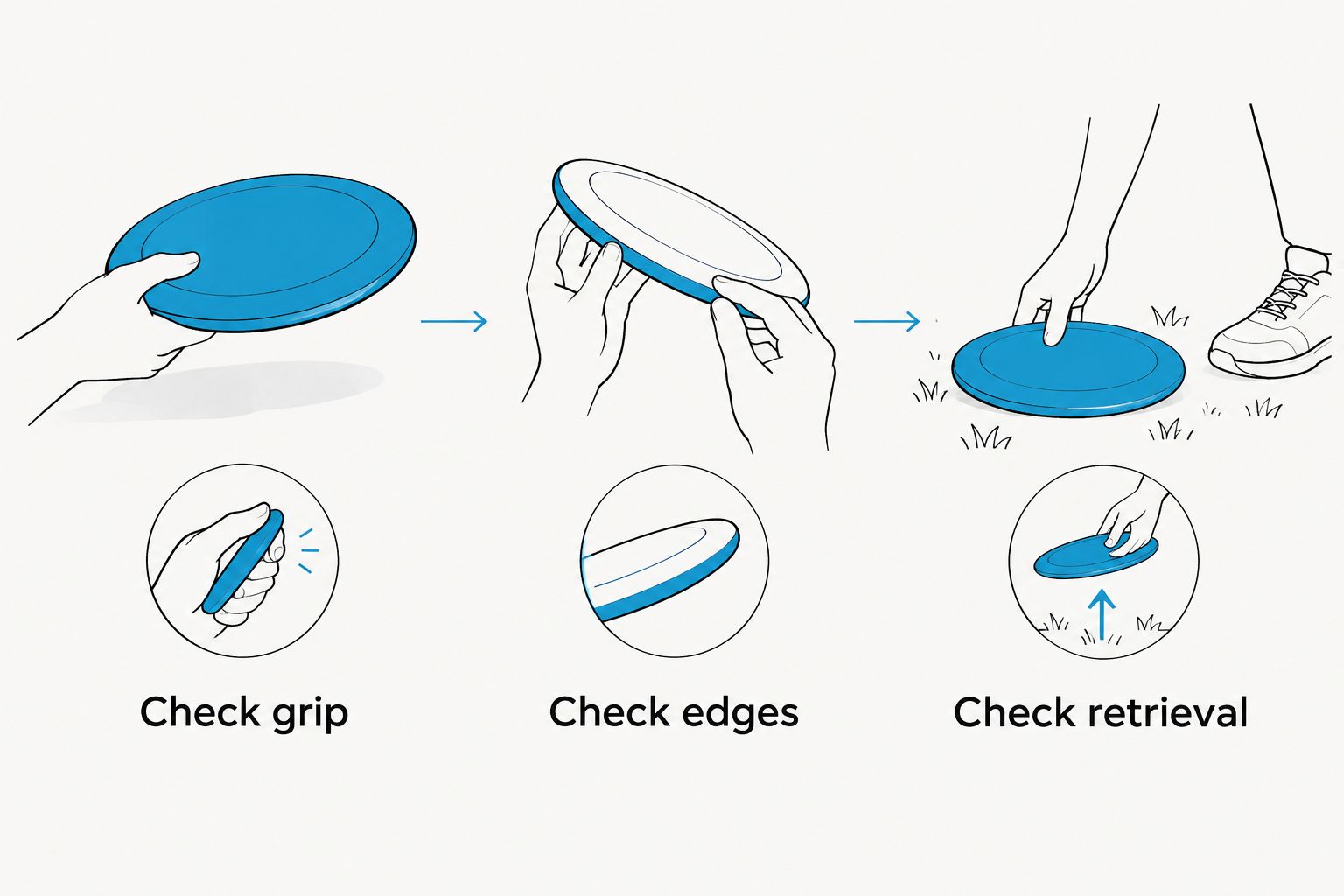
Make 3 fit checks before committing to a disc: grip, edges, and retrieval. Compare the listed dimensions with a toy your dog already handles comfortably. Do not choose a diameter from breed size alone, and do not assume that every lightweight disc has a flexible rim.
Check the full product information for material and dimensions. If a listing does not answer an essential fit question, ask before buying rather than filling the gap with an assumption. A toy that requires an awkward mouth position is not a useful beach purchase.
- Check grip: look for comfortable carrying without repeated repositioning.
- Check edges: inspect the rim for cracks, sharp damage, or rough areas.
- Check retrieval: watch whether your dog can lift the disc from flat ground.
- Compare the stated dimensions with a familiar, manageable toy.
- Stop the trial if your dog struggles to pick up or release the disc.
These checks happen before you test throwing distance. A comfortable pickup matters even when you intend to keep every retrieve low and close.
3. Match the toy to the retrieve you want
Start with the toy your dog already understands. A familiar ball is the straightforward choice for a dog that reliably retrieves balls but ignores discs. Choose a flying disc when your dog shows comfortable pickup and interest in returning it; do not buy one just because beach photos make aerial catches look appealing.
For 2026 shopping, Styleauditshop’s dog frisbee option is the Dog Training Flying Disc – Lightweight, Durable & Waterproof Fetch Toy for Puppies & Adult Dogs. It is best for shoppers seeking a disc-format fetch toy, subject to confirming fit. Its title does not establish flotation, comfortable sizing for every dog, or resistance to determined chewing.
The Squeaky Dog Ball Toy – Soft TPR Interactive Toy for Teeth Cleaning & Bite Resistance is best for shoppers comparing a ball with a disc for interactive play. Its squeaker gives it a different feature to consider, but the title does not establish dental results or suitability for every chewing style.
- Choose the disc format when your dog comfortably retrieves discs.
- Choose the ball format when familiar ball retrieval is the better task fit.
- Confirm dimensions before treating either toy as suitable for your dog.
- Treat dental and durability wording as claims to examine, not purchase reasons by themselves.
- Skip both for unsupervised chewing or unresolved swallowing concerns.
Compare these products by task and fit rather than assuming either is a beach-specific toy. Neither product description establishes that you should throw it into the sea.


4. Test controlled retrieves before beach throws
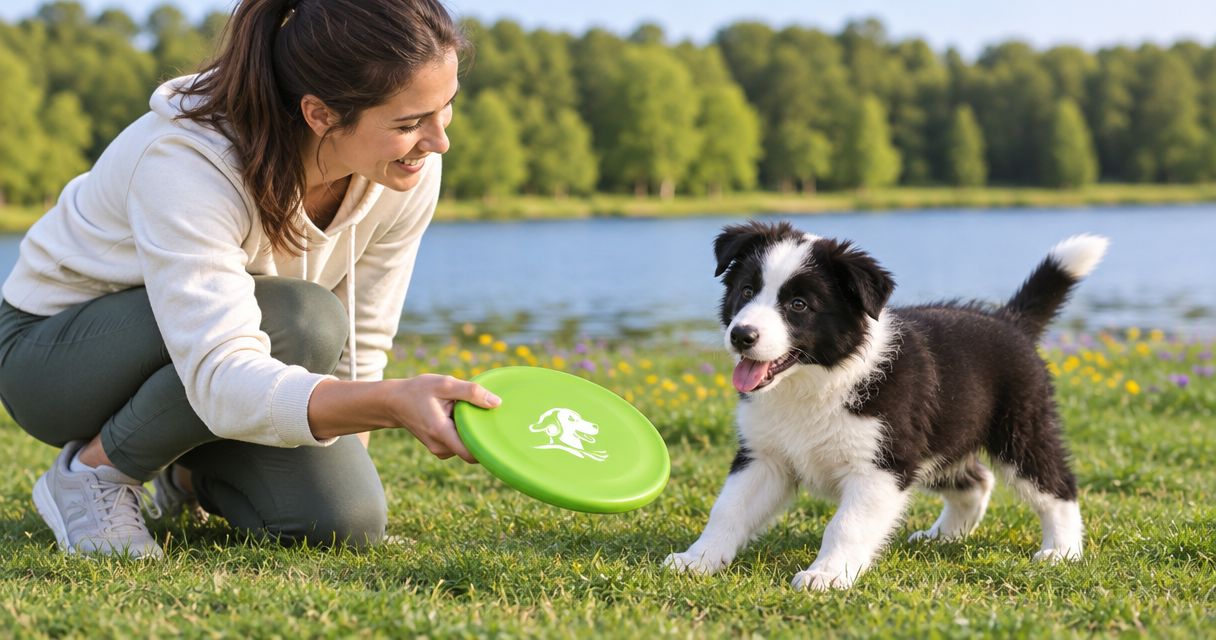
Introduce the disc on clear, dry ground before adding beach distractions. Let your dog investigate it, then practice a pickup and return without demanding an airborne catch. Reward returning and releasing the toy rather than chasing your dog to recover it.
At the beach, keep initial retrieves low and within the clear area you inspected. Do not throw toward the surf to test the toy or encourage jumping for the sake of distance. Windy conditions call for changing the activity, not throwing harder.
With multiple dogs, use 1 dog per retrieve as a practical starting rule. Separate turns let you observe pickup and return without a race for the same toy. If the dogs guard toys or crowd each other, abandon shared fetch.
- Practice pickup and release before adding throws.
- Keep throws low and directed away from the shoreline.
- Allow separate turns rather than competitive chasing.
- Pause when the disc drifts outside the intended route.
- Stop when your dog loses interest or shows discomfort.
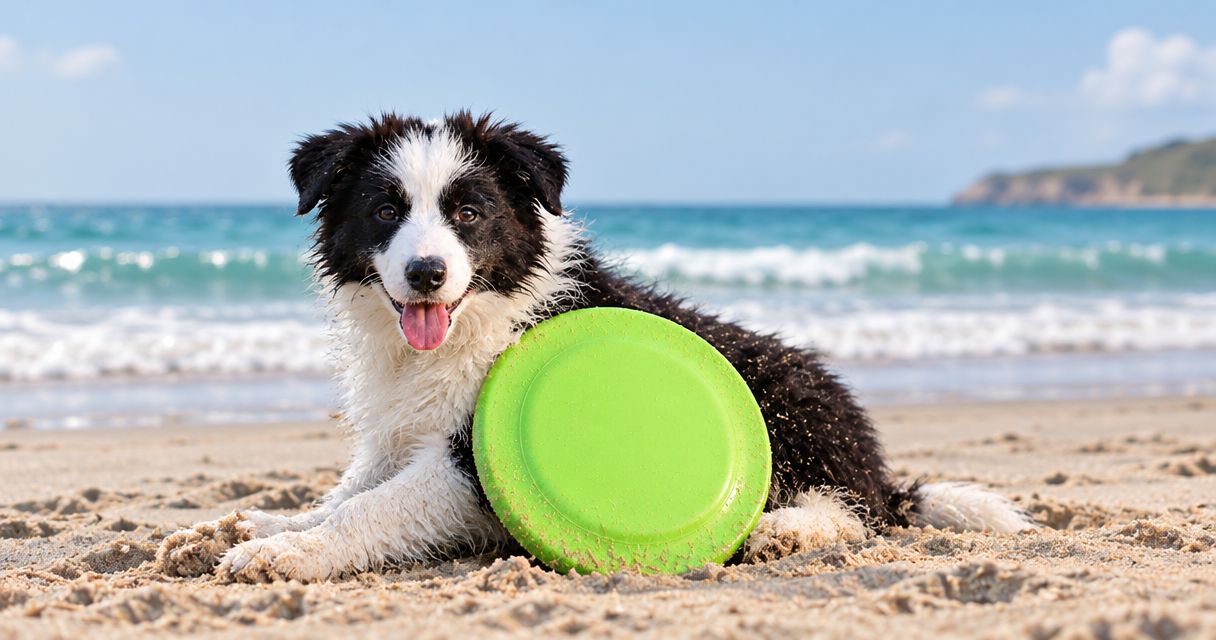
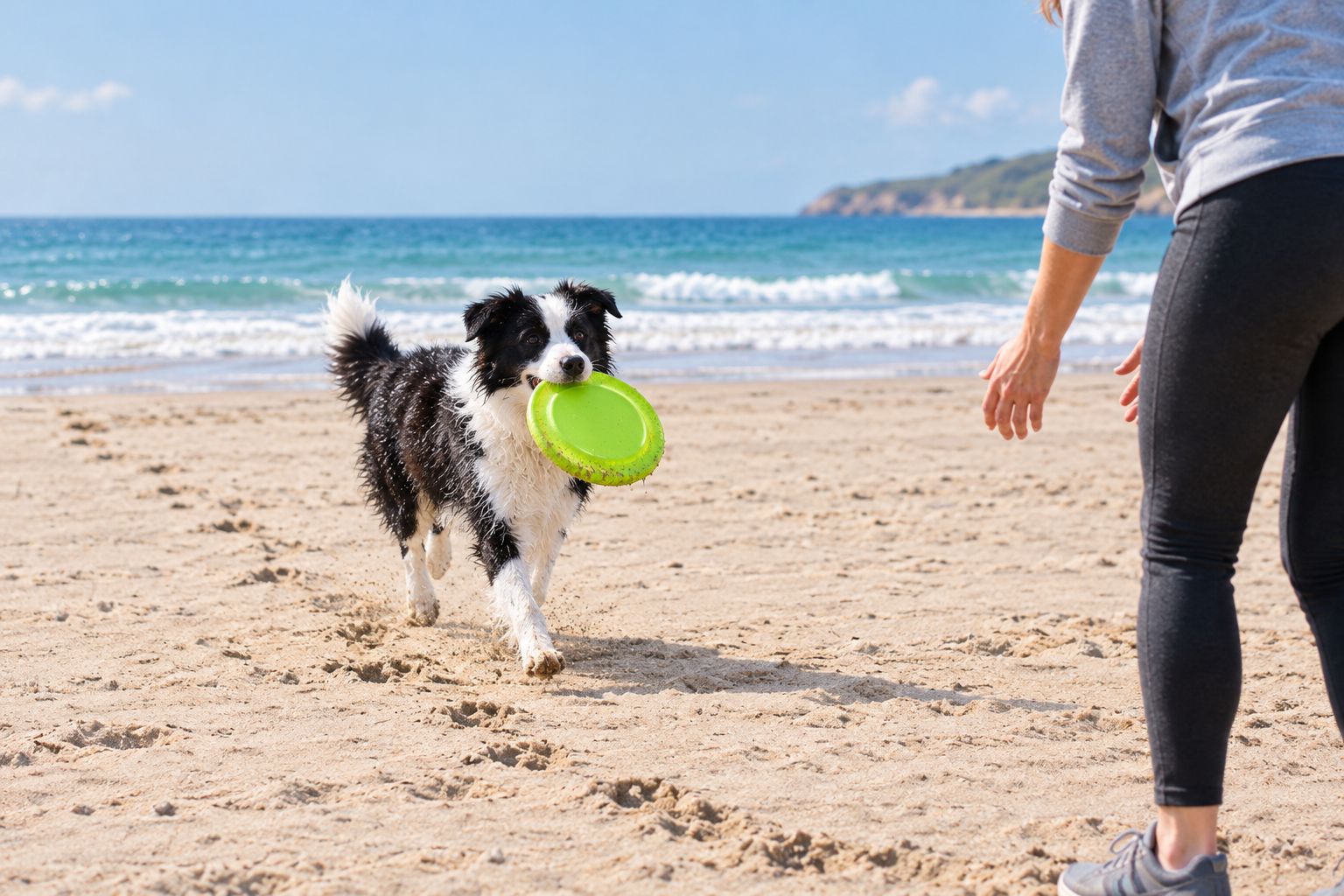
The useful scene is a controlled retrieve on open sand, not a dramatic leap beside breaking waves. You should be able to see the toy, the dog, and the whole return path.
5. Separate water resistance from water play
Read water-related wording literally. Waterproof is not the same as floating. A product title using waterproof does not answer whether the disc stays on the surface, remains easy to spot, or suits retrieval in surf.
Keep ordinary beach fetch on land unless water retrieval is a separate, appropriate activity for your dog and conditions. Never use a toy purchase as evidence that your dog is ready to swim. Avoid sea-water drinking, provide fresh drinking water, and contact a veterinarian if your dog becomes unwell after beach play.
For your 2026 checklist, treat a missing flotation statement as a reason to keep the disc out of the water. Do not send your dog after a drifting toy. Losing a toy is preferable to turning fetch into an unsafe retrieval.
- Check for an explicit flotation statement before considering water use.
- Keep throws away from surf, currents, and boats.
- Bring fresh drinking water and offer breaks from play.
- Prevent repeated sea-water drinking during retrieval.
- Leave a drifting toy rather than asking your dog to chase it.
6. Inspect and clean the toy after play
Use fresh water to remove loose sand and salt, following the toy’s care instructions. Inspect the rim and body before packing it away. Cleaning is also a chance to notice damage that excitement during play concealed.
Do not assume a fetch toy belongs in a dishwasher or tolerates harsh cleaners. Check the care guidance first, then dry it before storage. Remove a damaged toy from use rather than smoothing over a crack and continuing the session.
Build the inspection into your routine before the next outing. The useful question is not whether the disc still looks new, but whether its condition still supports supervised play without loose pieces or damaged edges.
- Rinse away visible sand and salt according to care guidance.
- Check the rim for cracks, splits, and rough damage.
- Remove toys with loose or separating parts from use.
- Dry the toy before storing it with other beach gear.
- Keep fetch toys separate from toys intended for chewing.
Compare your beach-play options for 2026
Compare 2 toy formats, a disc and a ball, alongside the option of not playing fetch. The best choice changes with your dog’s habits and the conditions; buying a disc is not always the next move.
| Option | Best for | Practical advantage | Key limitation |
|---|---|---|---|
| Dog flying disc | Dogs that comfortably pick up and return discs | Supports disc-format retrieve practice | Requires mouth-fit checks; water-related wording does not establish flotation |
| Squeaky dog ball | Dogs already interested in ball retrieval | Keeps play close to a familiar toy format | Size still needs checking; a squeaker does not establish beach suitability |
| Leashed beach walk | Dogs or conditions unsuited to fetch | Avoids throwing a toy toward crowds or water | Still requires permitted access, suitable conditions, and control |
Styleauditshop’s dog frisbee and ball options give you formats to compare, not a reason to ignore compatibility. Choose by the retrieve your dog can perform comfortably, then check the product details.
Common mistakes beach-going dog owners make
Treating waterproof as a flotation claim
Keep water resistance and buoyancy separate. If floating matters to your intended activity, look for an explicit statement rather than interpreting a title as permission for water retrieval.
Choosing for long throws instead of pickup
A disc your dog cannot comfortably lift is the wrong purchase, regardless of throwing ambitions. Check grip and release on the ground before asking for moving catches.
Letting beach fetch become chewing time
Supervise the retrieve and put the toy away when play ends. A fetch disc is not automatically suitable for prolonged chewing, and durability wording does not make damage irrelevant.
Continuing when the play area changes
Reassess when people arrive, wind picks up, or the shoreline moves closer to your route. The fact that fetch worked earlier does not make the current setup suitable.
FAQ
What should I check before buying a dog frisbee for the beach?
Check mouth fit, rim condition, comfortable pickup, and the intended play area. Confirm dimensions and any water-use statements separately rather than relying on puppy, adult, or waterproof wording.
Does a waterproof dog frisbee float?
Waterproof wording does not establish that a dog frisbee floats. Look for an explicit flotation statement, and keep throws on land when that point is unresolved.
Is a dog frisbee better than a ball for beach fetch?
A dog frisbee is the better fit only when your dog comfortably retrieves discs and the play area suits controlled throws. A familiar ball is the more straightforward choice for a dog that already returns balls reliably.
Can I use a dog frisbee as a chew toy after fetch?
Do not treat a fetch disc as a chew toy unless its intended use explicitly includes chewing. Supervise play and remove a toy that develops cracks, loose pieces, or damaged edges.
How do I introduce a dog frisbee at the beach?
Introduce pickup and release on clear, dry ground before adding beach distractions. Keep early retrieves low, away from the shoreline, and within an inspected play area.
Should I throw a dog frisbee into the sea?
Keep ordinary beach fetch on land rather than throwing into the sea. Water retrieval requires a separate assessment of your dog, the toy, and the conditions; never send your dog after a drifting toy.
When should I skip beach frisbee fetch?
Skip beach frisbee fetch when access rules prohibit it, recall is unreliable, or the area is crowded or unsuitable. Choose a permitted leashed walk instead of trying to make a toy solve those problems.
One last thing
For your next 2026 beach outing, practice picking the disc up from flat ground before packing it. That simple check reveals a practical problem a flying demonstration misses: your dog still needs to retrieve the toy after it lands. If pickup is awkward, change the toy or the activity.